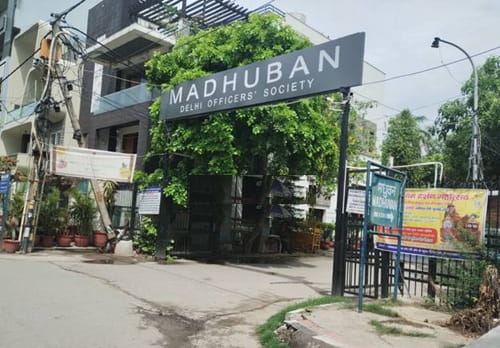
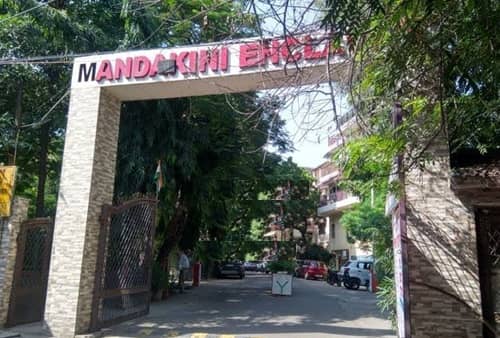
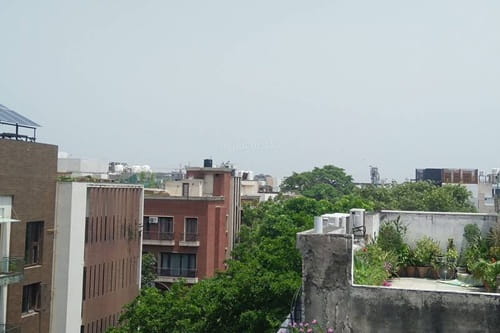
Pitampura gets discussed often in North Delhi conversations — its markets, its media offices, its TV tower visible from half of the Ring Road. Kohat Enclave sits within that larger Pitampura belt but carries a slightly different weight. It is a predominantly independent house and builder floor neighbourhood, denser and more residential in feel than the commercial stretches nearby, yet close enough to Netaji Subhash Place to benefit from all of that commercial energy without being inside it.
The enclave falls under PIN code 110034, within the Tri Nagar assembly constituency. The ward itself is named Kohat Enclave, which reflects how distinctly it registers as its own unit despite being administratively part of the Pitampura belt. Nearby localities include Sandesh Vihar, Vasudha Enclave, Saraswati Vihar, Tarun Enclave, and Pushpanjali Enclave — all part of the same residential cluster that fills out this corner of North West Delhi.
| Quick Overview | Details |
| Location | Pitampura, North West Delhi |
| PIN Code | 110034 |
| Assembly Constituency | Tri Nagar |
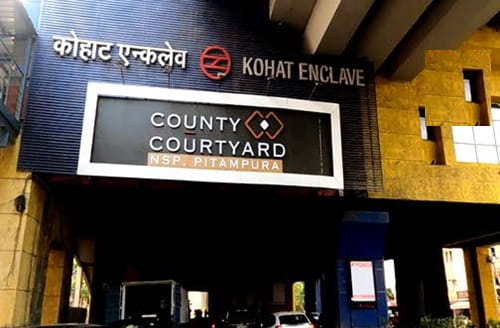
| Nearest Metro Station | Kohat Enclave Metro Station (Red Line) |
| Distance to NSP Commercial Hub | Approx. 2 km |
| Nearest Railway Station | Shakur Basti (~3 km) |
| Property Type | Predominantly independent homes, builder floors |
| Key BHK Configurations | 3 BHK and 4 BHK (resale segment) |
| Nearby Hospitals | Max Multi Specialty, Saroj Hospital, Muni Mayaram Jain Hospital |
The Neighbourhood and How It Is Laid Out
Kohat Enclave is not a grid of DDA flats. The housing stock here leans heavily toward independent houses — built over decades, some of them sizeable three and four-bedroom properties that families have held for generations. Builder floors have come up steadily over the past ten years, occupying plots where original structures have been redeveloped. The result is a neighbourhood where a freshly constructed four-floor builder floor with glass railings and video door phones sits adjacent to an older single-storey house with a front yard still used the way front yards were originally meant to be used.
The scale of the enclave is intimate without being cramped. Internal lanes are narrower than main roads but not unusably so. What the neighbourhood loses in parking flexibility — always a constraint in built-up Pitampura-area streets — it partially recovers in the sense of a contained, community-oriented residential pocket. Residents tend to know their immediate neighbours. That familiarity is not accidental; it comes from the housing typology.
The Lala Jagat Narayan Marg connects the enclave outward to the Outer Ring Road and Mahatma Gandhi Marg, giving the locality its road backbone. That connection matters for daily movement — it is the route through which residents reach both the Ring Road for longer Delhi distances and the local commercial belt for daily needs.
Metro Connectivity: What Has Changed Recently
Kohat Enclave has had a dedicated Red Line metro station since 31 March 2004 — one of the earlier stations on that corridor, connecting Rithala to the east toward Shaheed Sthal. The station sits right within the enclave and has been a primary daily transit point for residents for over two decades. Two parking lots are attached to the station, though availability during peak hours is competitive.
The bigger recent development is the opening of the Uttari Pitampura–Prashant Vihar station on the Magenta Line on 8 March 2026. This station, part of Delhi Metro Phase IV, is located on the Outer Ring Road at the Pitampura–Rohini boundary, adding a second metro line option to the broader neighbourhood. The Magenta Line extends commute reach toward Janakpuri South and the IGI Airport corridor — directions the Red Line alone did not serve well. For Kohat Enclave residents, this is a genuine connectivity upgrade that arrived in 2026.
Netaji Subhash Place Metro Station, roughly 2 kilometres away, is an interchange station serving both the Red Line and Pink Line, which extends the metro network reach further for residents willing to make a short commute to the interchange.
Employment and Commercial Proximity
The 2-kilometre distance to Netaji Subhash Place is worth dwelling on. NSP is not just a metro interchange — it is North Delhi’s most concentrated commercial hub. Office towers, shopping centres, the Dilli Haat near the metro gate, a multiplex, branded restaurant chains, and street food vendors all operate here. Wazirpur Industrial Area and Mangolpuri Industrial Area, both within 5 kilometres, add manufacturing and trading employment to the mix.
For working professionals, this proximity means a short commute to employment without the fatigue of a long metro or road journey. For families, it means weekend dining, shopping, and entertainment are accessible without planning around traffic. The NSP stretch has Burger King, Haldiram’s, CCD, Pizza Hut, and a range of mid-range dining options that residents use regularly. Street food — momos, Maggi, chaats — fills the gaps that branded outlets leave open.
Healthcare Infrastructure
Max Multi Specialty Hospital, Saroj Hospital, and Muni Mayaram Jain Hospital are the three frequently cited medical facilities within 2 kilometres of the enclave. Kuber Hospital and Choudhary Hospital offer additional options for routine care. Multiple clinics and diagnostic labs operate within the immediate locality, handling standard OPD consultations without requiring residents to drive to a larger hospital for every visit.
The hospital proximity to NSP in particular is useful — Max’s presence in that belt means specialist consultations, planned procedures, and emergency access are all practically reachable within the same 2-kilometre radius that serves daily commercial needs.
Schools in the Area
The Pitampura belt is well-supplied with schools. DAV Public School Pitampura, Rukmini Devi Public School, Shemrock School, PP International School, and Sachdeva Junior School are among the institutions serving the area. Shri Guru Gobind Singh College of Commerce, a Delhi University affiliate located near the Netaji Subhash Place metro station, serves students looking for undergraduate commerce education without travelling across the city.
Academic coaching centres and tuition hubs have established themselves throughout the Pitampura market, which means school-age children in Kohat Enclave have access to supplementary learning options at walking or short auto distance.
Property Market in 2026
Kohat Enclave sits within the broader Pitampura property belt, where rates as of March 2026 range from ₹12,600 to ₹27,500 per sq. ft. depending on the specific block, floor, and property condition. The enclave’s independent house and builder floor stock — predominantly 3 and 4 BHK units — attracts buyers who want more space than a standard apartment provides and are willing to pay the premium that comes with a freehold independent property in a well-connected North Delhi location.
Rental demand is driven by proximity to NSP employment and metro access. Monthly rents in the Pitampura belt run from ₹11,900 to ₹84,000 depending on size and furnishing, with the Kohat Enclave premium segment sitting toward the upper end of that range for well-maintained 3 and 4 BHK floors. The resale segment is active, though listings move slowly — owners of independent properties here tend to hold rather than exit, which keeps supply constrained and prices supported.
One pending civic improvement to note: Lala Jagat Narayan Marg has been identified for redesign and beautification to reduce traffic bottlenecks. The timeline for that work has not been finalised as of mid-2026, but it is on record as a planned intervention.
Living Here: The Honest Picture
Kohat Enclave’s challenges are familiar to anyone who knows North Delhi’s older residential belts. Unauthorised parking in service lanes creates pedestrian inconvenience. The Ring Road stretch between Netaji Subhash Place and Rohini slows significantly during morning and evening peak hours. The presence of Shakurpur Basti slums within 3 kilometres is an acknowledged eyesore for residents. Winter air quality follows Delhi’s city-wide pattern — the months between October and January bring AQI deterioration that no single locality can resolve independently.
What stays in the enclave’s favour is a combination that North Delhi buyers find difficult to replicate elsewhere at comparable cost. An original-era metro station with two parking lots on its doorstep. A new Magenta Line station opened in 2026 extending commute options. A major commercial hub 2 kilometres out. Solid healthcare within the same radius. Housing stock dominated by spacious independent properties rather than compact apartments. For families prioritising space, connectivity, and a neighbourhood that functions rather than just looks good on a map, Kohat Enclave continues to make a credible case.
FAQs
Q1. What is the PIN code of Kohat Enclave, Pitampura?
110034. The area falls within the Tri Nagar assembly constituency and has its own dedicated ward under the same name.
Q2. Which metro lines serve Kohat Enclave?
The Red Line’s Kohat Enclave Station is directly in the locality, operational since 2004. The newly opened Uttari Pitampura–Prashant Vihar station on the Magenta Line, inaugurated in March 2026, is also now accessible for residents.
Q3. How far is Netaji Subhash Place from Kohat Enclave?
Around 2 kilometres. NSP is North Delhi’s main commercial hub with offices, malls, restaurants, a multiplex, and an interchange metro station serving both the Red and Pink Lines.
Q4. What type of housing is available in Kohat Enclave?
The enclave is dominated by independent houses and builder floors, mostly in 3 BHK and 4 BHK configurations. Apartments are present but less common than the resale independent property stock.
Q5. What are the hospitals near Kohat Enclave?
Max Multi Specialty Hospital, Saroj Hospital, and Muni Mayaram Jain Hospital are all within roughly 2 kilometres, along with Kuber Hospital and several clinics for routine care.