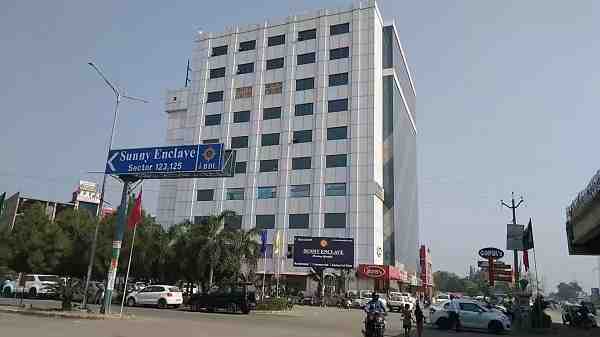
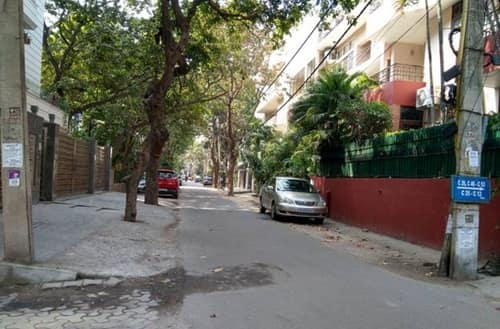
There are South Delhi addresses that announce themselves loudly — Defence Colony, Greater Kailash, Hauz Khas. Nehru Enclave is not one of those. It occupies a quieter register in the South Delhi residential hierarchy: a premium locality tucked inside the Kalkaji area, bounded by Nehru Place on one side and Pamposh Enclave and Chirag Delhi on the other, with a Magenta Line metro station sitting right in Block C bearing its name. Ten years ago, residents here drove everywhere. Today, the commute dynamic has shifted entirely.
Nehru Enclave falls under PIN code 110019 in South Delhi, within the Kalkaji tehsil. The locality sits on Chittaranjan Park Road as its main access spine, with the broader Kalkaji neighbourhood wrapping around it. For address purposes it registers under South Delhi, which carries the weight that South Delhi addresses carry in the city’s residential consciousness — though Nehru Enclave’s prices and character put it firmly in the premium-to-luxury bracket rather than the accessible mid-segment.
| Quick Overview | Details |
| Location | Kalkaji, South Delhi |
| PIN Code | 110019 |
| Metro Station | Nehru Enclave (Magenta Line, underground) |
| Nearest Interchange Station | Kalkaji Mandir (Violet + Magenta Line) |
| Nearest Commercial Hub | Nehru Place (~0.1 km from metro station) |
| Nearest Landmarks | Lotus Temple (~2 km), ISKCON Temple (~1.4 km) |
| Nearest Railway Station | Okhla Railway Station |
| Key Nearby Localities | Pamposh Enclave, Chirag Delhi, Kalkaji, Greater Kailash |
| Property Range | 3 BHK: ₹3.75 Cr–₹10.75 Cr; 4 BHK: ₹6.9 Cr–₹11.5 Cr |
The Neighbourhood: Premium Builder Floors and Green Pockets
Nehru Enclave is classified as a luxury locality in South Delhi’s property market. The housing stock is dominated by builder floors — freshly constructed independent floors, typically four storeys tall, offering 3 BHK and 4 BHK configurations with attached bathrooms, stilt parking, lifts, servant quarters, and park-facing orientations. The scale and finish of these properties reflects a buyer segment willing to spend upwards of ₹4 crore for a home that delivers space, light, and a South Delhi address without the institutional density of a large apartment society.
What residents consistently note about the enclave is the green coverage. Trees line the internal streets, parks are well-maintained, and the Aastha Kunj Park sits within the immediate neighbourhood. For a locality this close to Nehru Place’s commercial intensity, the residential streets feel unusually calm. That contrast — the controlled quiet of the enclave versus the perpetual activity of Nehru Place barely 500 metres away — is one of those neighbourhood qualities that only becomes apparent after spending time here.
The Devika Tower is a landmark residential building in the area, frequently cited by residents who have experienced strong value appreciation on their investments. Eros Intercontinental, the hotel on the Nehru Place-Kalkaji border, serves as one of the prominent commercial anchors visible from the enclave’s outer edges.
The Veer Savarkar Government Sarvodaya Kanya Vidyalaya sits within the enclave, providing a government secondary school option for residents who need accessible public education.
Metro Connectivity: The Magenta Line Advantage
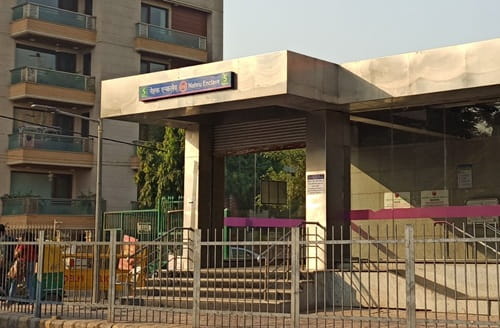
Nehru Enclave Metro Station is underground, on the Magenta Line, and opened on 29 May 2018. It sits between Kalkaji Mandir and Kailash Colony on the corridor that runs from Janakpuri West in the west to Botanical Garden in Noida in the east. The station is Divyang-friendly, with lift and escalator access.
What this means practically: residents can reach IGI Airport directly via the Magenta Line without changing trains — a straight corridor through Saket, Hauz Khas, IIT Delhi, and onward. Heading east, the line connects through Jasola-Apollo, Okhla NSIC, and into Noida at Botanical Garden. For professionals working in Nehru Place — literally 100 metres from the metro station’s exit — the commute from Nehru Enclave is measured in minutes, not kilometres.
The interchange at Kalkaji Mandir, one stop away, is where the Magenta Line meets the Violet Line. The Violet Line adds connectivity northward toward Kashmere Gate, Mandi House, and Central Delhi, and southward toward Faridabad (Raja Nahar Singh/Escorts Mujesar). Between the two lines, most Delhi and Noida commute directions are covered without relying on road travel.
Nehru Place Metro Station on the Violet Line is also within the immediate vicinity, giving the enclave access to a second metro station within short walking distance. That kind of multi-station access in South Delhi is uncommon and adds to the enclave’s practical value for daily commuters.
Chirag Dilli Metro Station on the Magenta Line is also reachable nearby, and Okhla Railway Station serves inter-city rail needs for the broader area.
Nehru Place: The Commercial Neighbour That Changes Everything
Most residential localities in Delhi are defined by what surrounds them. Nehru Enclave is defined more than most by its proximity to Nehru Place — South Asia’s largest electronics market, a concentrated IT and financial services hub planned by DDA in the 1970s and now host to hundreds of technology companies, chartered accountancy firms, and the country’s most active flea market for gadgets, laptops, printers, and peripherals.
For residents, this proximity cuts two ways. Office commutes disappear to a short walk. The enclave generates consistent rental demand from working professionals who want to live within metres of their workplace. Dining, fitness, and services are abundantly available in the commercial belt just outside. On the other side, parking is a genuine daily challenge — it is the single most consistently raised complaint among enclave residents and Nehru Place’s broader neighbourhood — and the area near Kalkaji Mandir gets waterlogged during heavy monsoon rain, a recurring civic maintenance issue.
Nexus Select CityWalk in Saket, Apollo Spectra Hospital, and multiple dining and entertainment options in the South Delhi arc are all accessible within a short metro or cab ride.
Temples and Landmarks: Living Beside Two of Delhi’s Best-Known Spiritual Sites
Nehru Enclave sits within easy reach of two of Delhi’s most visited religious landmarks. The Lotus Temple — the Bahá’í House of Worship known globally for its remarkable flower-like architecture — is approximately 2 kilometres away. The ISKCON Temple (Sri Sri Radha Parthasarathi Mandir) in East of Kailash, inaugurated in April 1998, is roughly 1.4 kilometres out. Kalkaji Mandir, the ancient temple dedicated to Goddess Kali, is approximately 1.5 kilometres from the metro station.
Residents who have lived in the enclave for a decade or more specifically mention these proximity advantages as part of what makes the neighbourhood feel distinctive within South Delhi’s dense urban fabric. A ten-minute walk to the Lotus Temple’s grounds on a weekend morning is a quality of daily life that no amount of indoor amenity can replicate.
The Okhla Bird Sanctuary, roughly 4 kilometres away at the Delhi–Noida border, draws nature and birdwatching interest from enclave residents particularly during winter migration months.
Healthcare and Education
Fortis C-DOC Hospital is 0.7 kilometres from the enclave — one of Delhi’s specialist centres for diabetes and obesity care, operated under the Fortis network. Sukhda Hospital at 1.4 kilometres handles general and secondary care. Pt. Madan Mohan Malviya Hospital is accessible within the broader South Delhi network at approximately 3.6 kilometres. Phoenix Hospital is also cited among nearby options. Multiple private clinics and diagnostic centres handle routine medical needs within the locality.
For schools, SDMC Pratibha School (0.5 km) is the nearest primary option. Guru Harkrishan Public School at 1.1 kilometres and Jagannath International Management School Kalkaji at the same distance serve secondary and higher secondary levels. Deshbandhu College and Acharya Narendra Dev College, both Delhi University affiliates, are accessible within 1.3 to 2.4 kilometres for undergraduate education.
Mother’s Pride and Early Years serve early childhood at 0.8 and 1 kilometre respectively — relevant for young families factoring in preschool access as part of their housing decision.
Property Market: Where Nehru Enclave Sits in 2026
Nehru Enclave is unambiguously a premium market. The 3 BHK builder floor segment runs from ₹3.75 crore to ₹10.75 crore. Four BHK configurations start at ₹6.9 crore and go up to ₹11.5 crore. These are not anomalies — they reflect the consistent pricing for well-located, newly constructed builder floors in the South Delhi premium belt.
Rental demand from Nehru Place’s working professional population keeps occupancy rates high and rental values elevated. The Kalkaji belt’s rental range runs from ₹18,000 to ₹99,000 per month depending on configuration and furnishing. The Nehru Place belt — which includes Nehru Enclave — commands rents from ₹30,000 to ₹2,00,000 for 1 to 3 BHK apartments.
Value appreciation here has been consistent. Residents with long-term ownership — one decade or more — report strong capital gains. The combination of Magenta Line metro access, Nehru Place commercial proximity, South Delhi address, and landmark accessibility makes Nehru Enclave one of the more defensible investment choices in the city’s premium residential belt.
Living Here: The Honest Picture
Nehru Enclave is not for every budget. Entry prices are high, maintenance costs for premium builder floors add to monthly outgoings, and parking is a daily frustration that no amount of civic planning has resolved in this corner of South Delhi. The commercial intensity of Nehru Place brings noise, footfall, and road congestion that bleeds into the enclave’s edges, particularly near the Outer Ring Road side.
What the locality delivers in return is a residential quality that is hard to replicate at comparable South Delhi addresses. Dedicated Magenta Line metro access to IGI Airport, Saket, and Noida. Walking distance to Nehru Place employment. The Lotus Temple, ISKCON, and Kalkaji Mandir forming the spiritual and social geography of the neighbourhood. Maintained parks and tree cover that make the internal streets feel removed from the city outside. For buyers who can meet the entry price, Nehru Enclave earns its premium.
FAQs
Q1. What is the PIN code of Nehru Enclave, South Delhi?
110019. The locality falls within the Kalkaji tehsil of South Delhi, with the same PIN code covering Kalkaji and parts of Nehru Place.
Q2. Which metro stations serve Nehru Enclave?
Nehru Enclave Metro Station on the Magenta Line is the primary station, located in Block C of the enclave. Kalkaji Mandir — one stop away — is an interchange between the Magenta and Violet Lines. Nehru Place Metro Station on the Violet Line is also within close reach.
Q3. How far is the Lotus Temple from Nehru Enclave?
Approximately 2 kilometres. The ISKCON Temple in East of Kailash is roughly 1.4 kilometres, and Kalkaji Mandir is about 1.5 kilometres from the enclave’s metro station.
Q4. What are property prices in Nehru Enclave?
3 BHK builder floors range from ₹3.75 crore to ₹10.75 crore. 4 BHK configurations go from ₹6.9 crore to ₹11.5 crore. Rentals in the area run from ₹30,000 to ₹2,00,000 per month depending on size and furnishing.
Q5. Which hospitals are nearest to Nehru Enclave?
Fortis C-DOC Hospital is 0.7 kilometres away, specialising in diabetes and obesity care. Sukhda Hospital at 1.4 kilometres handles general medical needs. Phoenix Hospital is also cited among nearby options.